Paper, Pens & the Art of Putting Things Down

All Articles

Everything published on The Daily Nib — sorted by newest first.

Notebooks, Planners & Diaries The Notebook That Grows With You

On the notebook system that travels through life with you — and never really needs replacing.
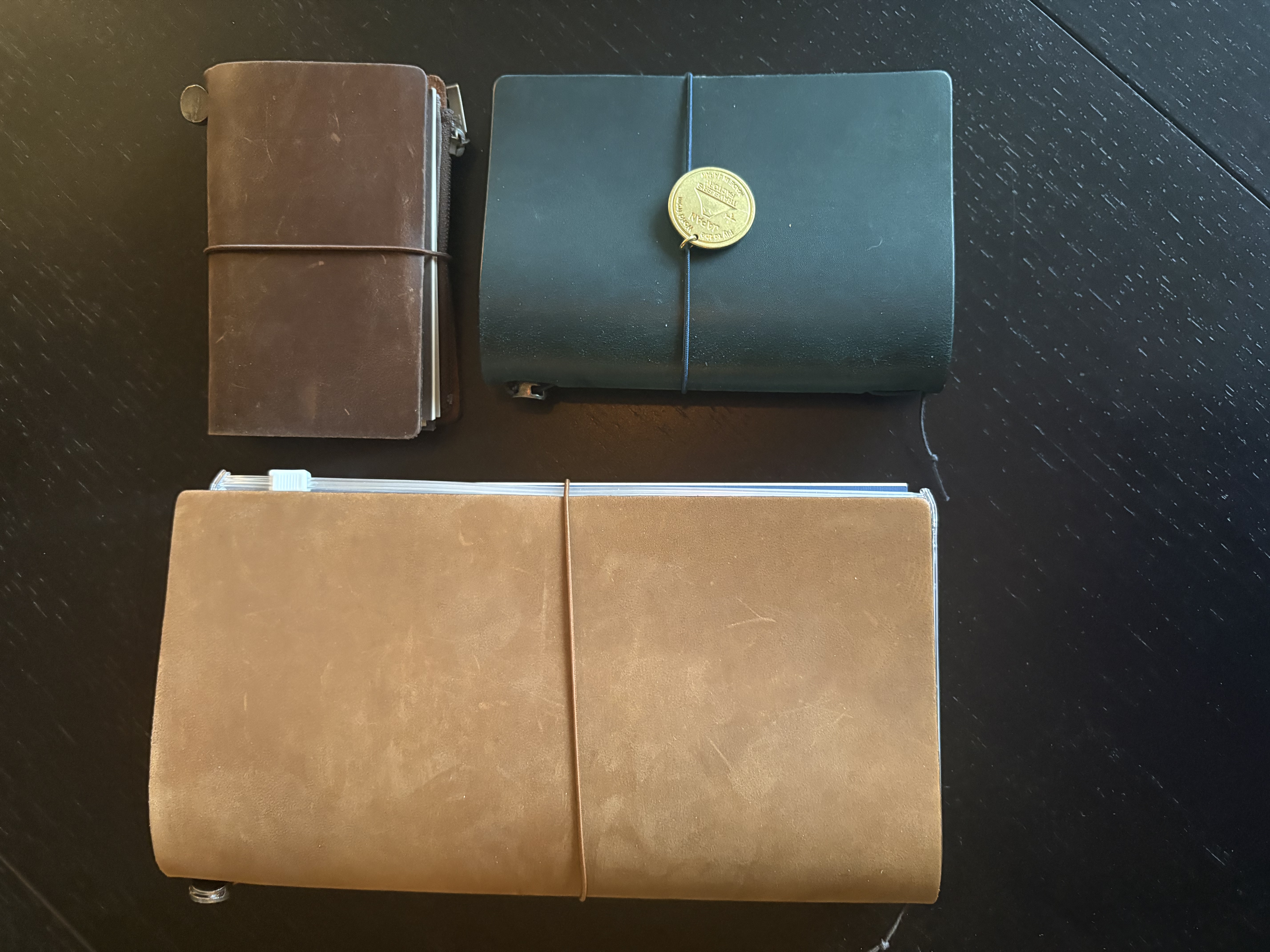
The Notebook That Grows With You

There are some stationery products that you admire from afar for years before finally trying them yourself. For me, Traveler's Notebook was one of them.

I'd admired the beautiful leather covers, watched countless videos and wondered whether I would actually use one. It wasn't until this spring that I finally bought my first Traveler's Notebook.

I now own… a few.

Apparently, that's how these things go.

At first glance, the concept couldn't be simpler. A beautifully crafted leather cover, a handful of elastic bands and a collection of replaceable notebook inserts may not sound particularly revolutionary, yet together they create one of the most thoughtful notebook systems I've ever come across. Rather than replacing the entire notebook once it's full, you simply swap the insert for a new one while the leather cover stays with you, gradually becoming part of your story.

Unlike a traditional notebook, a Traveler's Notebook is never really finished. The cover remains the same while the inserts change as your life changes. A journal becomes a reading log, a travel diary becomes a sketchbook, one notebook fills up and another quietly takes its place. Over time, the leather softens, the corners wear in and the scratches begin to tell their own story. That, to me, is the real beauty of the Traveler's Notebook system. It isn't designed to stay perfect; it's designed to stay with you.

"It isn't designed to stay perfect; it's designed to stay with you."

A notebook designed to last

Traveler's Notebook was first introduced in 2006 by the Japanese company Midori, now known as Traveler's Company. Their vision was beautifully simple: to create a notebook that would become more personal with every passing year rather than something to be replaced.

Unlike planners that are swapped for a new version every January, the leather cover is intended to last for decades. It develops a rich patina over time and quietly reflects the life of the person carrying it. Few stationery products seem to celebrate wear and tear in quite the same way. Instead of trying to preserve it, you're encouraged to use it, take it everywhere and allow it to become uniquely yours.
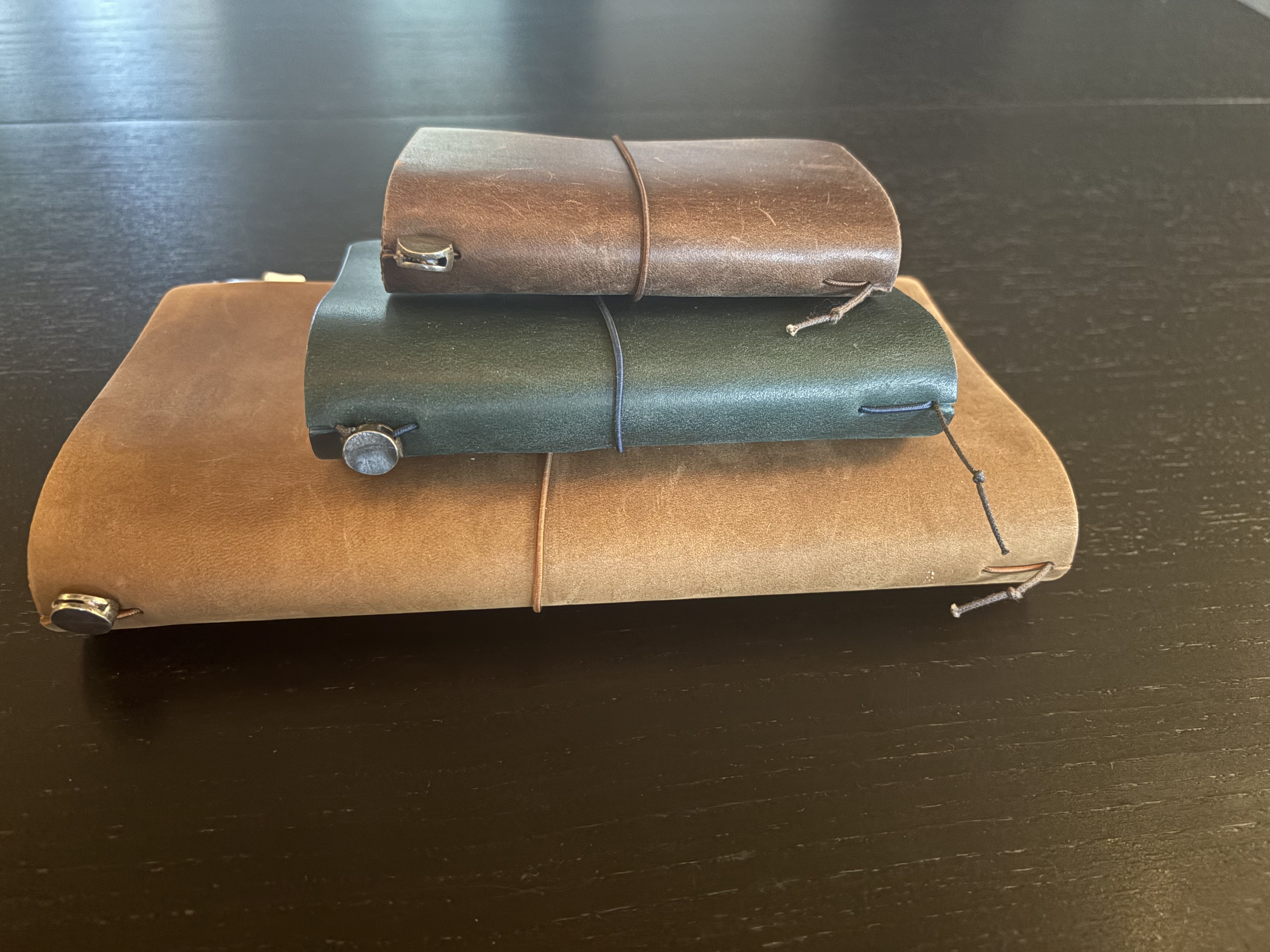
Traveler's Notebooks stacked

A little fun fact

One detail that surprises many people is the "Made in Thailand" stamp on the back of every Traveler's Notebook. I remember wondering the same thing when I bought mine. Wasn't this supposed to be Japanese?

It is.

Traveler's Company is a Japanese brand, and all of the design and product development happens in Japan. The leather covers, however, are handcrafted in Thailand, where the company found exactly the level of craftsmanship they were looking for. Many of the notebook inserts, including those made with the wonderfully fountain pen-friendly Midori MD Paper, are still produced in Japan. It's one of those little details that often catches people by surprise until they know the story behind it.

More than just a travel notebook

Despite the name, I don't believe a Traveler's Notebook has to travel anywhere.

Mine spends just as much time on my desk as it does in my bag. It works beautifully as a journal, a reading log, a notebook for work, a place to collect ideas or simply somewhere to slow down and write for a few minutes at the end of the day. Of course it's perfect for documenting adventures abroad, but I think its real strength lies in how effortlessly it fits into everyday life.

Perhaps the word traveler was never really about travelling to different places.

Perhaps it was always about travelling through life.
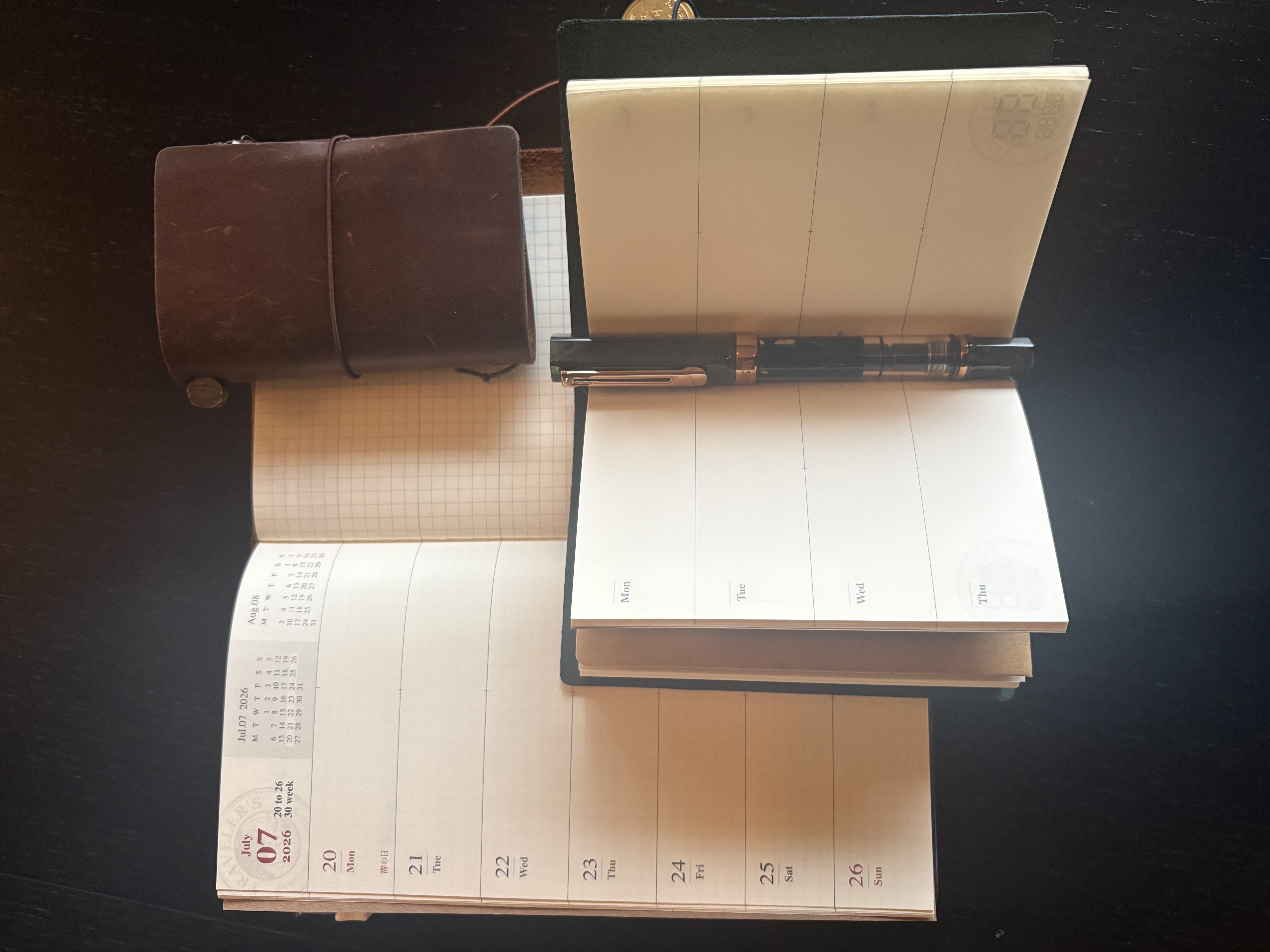
Traveler's Notebook inserts open

Thoughtful by design

One of the reasons I'm so drawn to Japanese stationery is the incredible attention to detail. Nothing feels overdesigned or added simply for decoration. Every decision seems intentional, from the materials and craftsmanship to the paper itself.

Traveler's Notebook captures that philosophy beautifully.

Many of the inserts use Midori MD Paper, which has become something of a favourite among fountain pen enthusiasts. It handles ink exceptionally well, feels wonderful under the nib and somehow makes writing feel slower, calmer and more intentional. Like so many Japanese stationery products, it quietly reminds you that even the simplest everyday objects can be made with extraordinary care.

My only challenge

The only challenge is that I genuinely enjoy trying different notebook systems.

Every notebook has its own personality, and I find myself drawn to different ones at different times. Part of me loves the idea of filling a single notebook from cover to cover over an entire year, while another part is endlessly curious to discover what another system might offer.

I'm still trying to find the perfect balance.

Although, if I'm honest, I'm beginning to suspect that constantly trying new notebooks is simply part of the hobby.

A notebook that stays

Perhaps that's what I love most about the Traveler's Notebook.

In a world where so many things are designed to be replaced, it was designed to stay.

The inserts are meant to change as your life changes, but the leather cover simply keeps travelling with you, quietly collecting memories along the way. It becomes a little softer every year, the scratches begin to tell their own story and, before long, it feels less like something you own and more like something that has quietly accompanied you through different chapters of your life.

I like the idea that years from now it won't look new anymore.

I hope it doesn't.

I hope it'll be softened by time, marked by everyday adventures and filled with memories I'd almost forgotten until the moment I pick it up again.

There's something incredibly comforting about owning an object that's designed to grow older with you rather than be replaced.

Final thoughts

When I first bought a Traveler's Notebook, I thought the magic was in the leather cover.

Now I think it's something much simpler.

It's the freedom to adapt it as your life changes. The freedom to rearrange it, refill it and shape it into exactly what you need, instead of trying to fit yourself into someone else's idea of the perfect notebook.

Perhaps that's why so many people buy one…

…and never really stop using it.
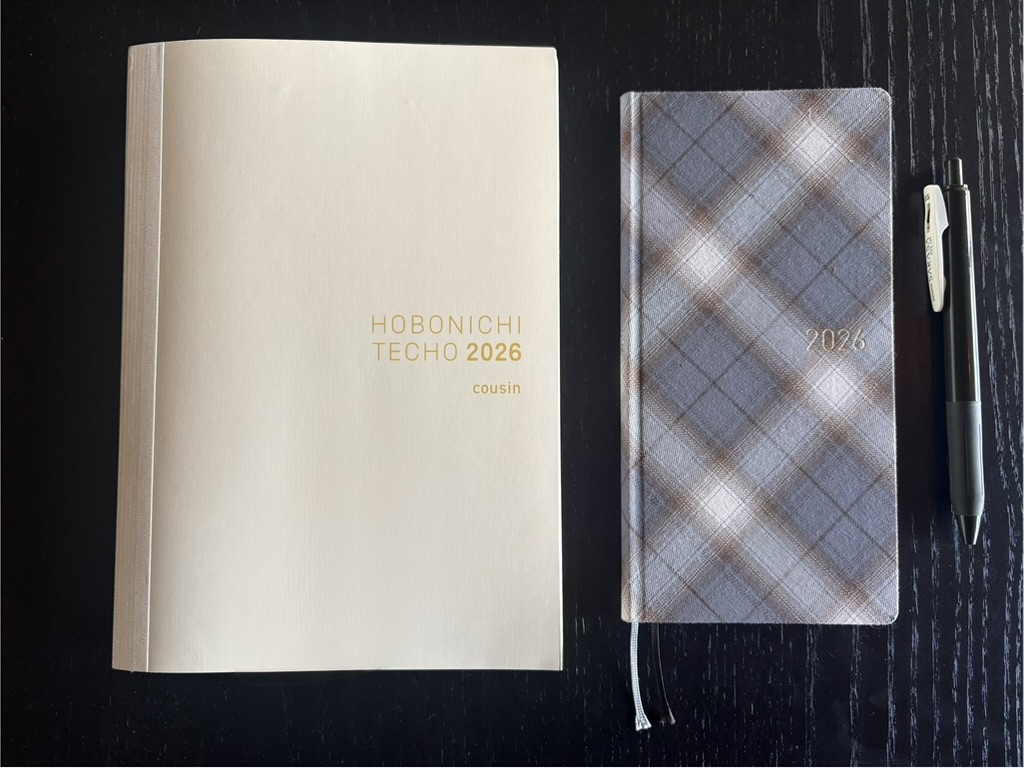
Notebooks, Planners & Diaries The Beginning of Hobonichi Season

Every year it arrives. Every year I fail spectacularly at waiting.

The Beginning of Hobonichi Season

For most people, 1 August is just another summer day.

For Hobonichi lovers, it's the beginning of something rather special.

Every year, Hobonichi begins unveiling its collection for the year ahead. Not all at once, but little by little over the weeks that follow. New planners, beautiful covers, accessories, and plenty of little surprises that somehow make checking the website part of my daily routine.

I genuinely look forward to it every single year.

It's never just about choosing a planner. There's something quietly exciting about imagining the year ahead before it has even begun. Fresh pages waiting to be filled. New routines. New adventures. Books yet to be read. Trips yet to be taken. Memories that haven't happened yet.

Somehow, an empty planner manages to hold all of that.

Perhaps that's why Hobonichi season feels so special. It's not really about stationery at all. It's about possibility.

"It's not really about stationery at all. It's about possibility."

This year is no different.

I'm already debating the important questions. Will it be a Cousin or a HON? Should I get a Weeks as well? What colours will this year's Weeks come in? What patterns will they dream up for the HON? And will there be a cover so beautiful that I'll somehow convince myself it simply has to come home with me?

Every year I tell myself I'll wait until I've seen the entire collection before making a decision.

Every year I fail spectacularly.

I'll almost certainly be sharing my favourite covers here on The Daily Nib over the coming weeks. I'll compare colours, layouts and cover combinations far more than any sensible person should, and I'll probably create at least three completely different wishlists before finally placing my order.

Right now I'm telling myself it'll probably be either a Cousin or a HON… and maybe a Weeks.

Ask me again in September.

Pens & Ink The little crayon that took me straight back to childhood

Penco's 8 Colour Crayon is nostalgic, practical and completely irresistible.

The little crayon that took me straight back to childhood

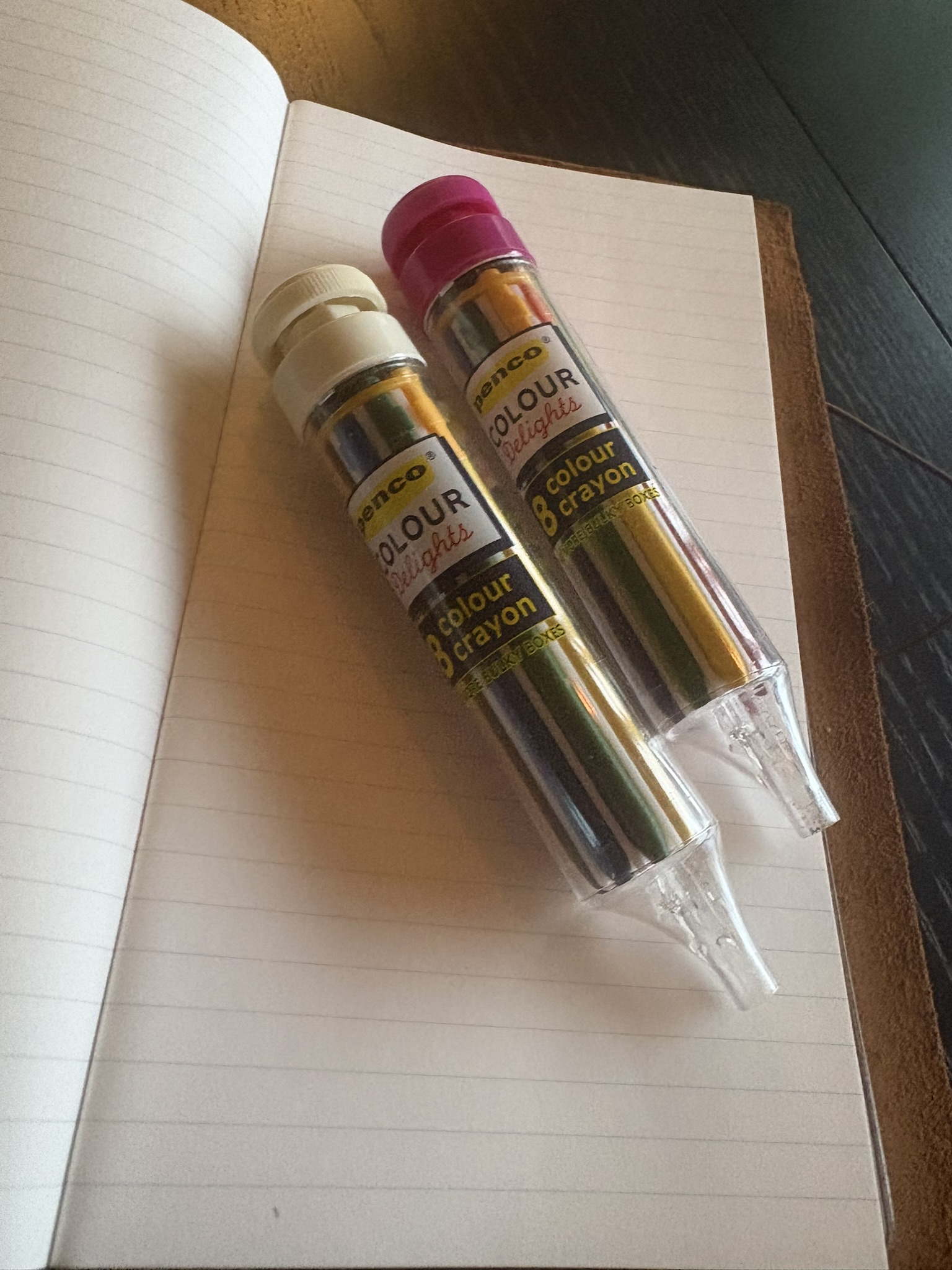
The moment I saw this little crayon pen from Penco, I was instantly transported back to my childhood.

Do you remember those stackable crayons? Each colour was its own little crayon, and you stacked them on top of one another to make one long pen. When you wanted a different colour, you simply took the top one off and clicked it onto the bottom.

I absolutely loved them.

When I spotted Penco's 8 Colour Crayon, it reminded me of that same idea — but reimagined for grown-ups who still get excited about stationery.

Instead of eight tiny crayons rattling around in a box, everything is neatly tucked inside one beautifully designed little pen. It takes up hardly any room in a pencil case, making it perfect for journaling on the go, travelling or simply adding a little colour to your planner without carrying half your stationery collection with you.

I couldn't resist and ended up buying both the pink and the ivory version. At least one of them is definitely coming with me to Italy this summer, although knowing myself… it'll probably be both. And since my kids have a habit of "borrowing" my stationery, packing an extra one might not be the worst idea.

It's not a revolutionary invention, and Penco certainly didn't invent the idea of combining several colours into one pen. What they have done is take a wonderfully nostalgic concept and turn it into something that feels thoughtful, practical and, of course, incredibly beautiful.

"Some stationery is useful. Some makes you smile. And every now and then, you find something that does both."
Pens & Ink The Fountain Pen That Started It All

Why the TWSBI ECO remains the pen I recommend more than any other.

The Fountain Pen That Started It All

There are fountain pens that cost hundreds of pounds.

There are fountain pens made from precious materials, limited editions that sell out in minutes, and pens that spend more time in display cases than on paper.

And then there's the TWSBI ECO.

It wasn't just my first fountain pen. It was the pen that changed everything.

Before I bought it, fountain pens felt like something mysterious. Beautiful, certainly, but also slightly intimidating. They seemed to belong to collectors and experts — people who knew all about nib sizes, inks and paper.

The ECO changed that. It was approachable, beautifully made and, perhaps most importantly, it invited me to simply start writing.

A company built around one idea

Although TWSBI feels like a relatively new name in the fountain pen world, its roots go much deeper.

The company was founded in Taiwan by a family with decades of experience manufacturing writing instruments for other brands before deciding to create pens under their own name.

The name TWSBI itself is derived from the Chinese phrase San Wen Tong, which roughly translates to "hall of three cultures," combined with the initials BI, inspired by the word writing instrument. The idea was to create beautifully engineered fountain pens that were accessible to everyday writers, not just collectors.

That philosophy is still reflected in the ECO today.

Why the ECO became so popular

There are plenty of reasons people recommend the ECO as a first fountain pen.

It's affordable. The piston-filling mechanism holds an impressive amount of ink. The transparent barrel lets you enjoy watching the ink slosh around inside (which is oddly satisfying). And it writes remarkably well for its price.

You get a pen that feels thoughtfully engineered without spending a small fortune. Quite simply, you get an awful lot of pen for your money.

Mine became the beginning of a collection

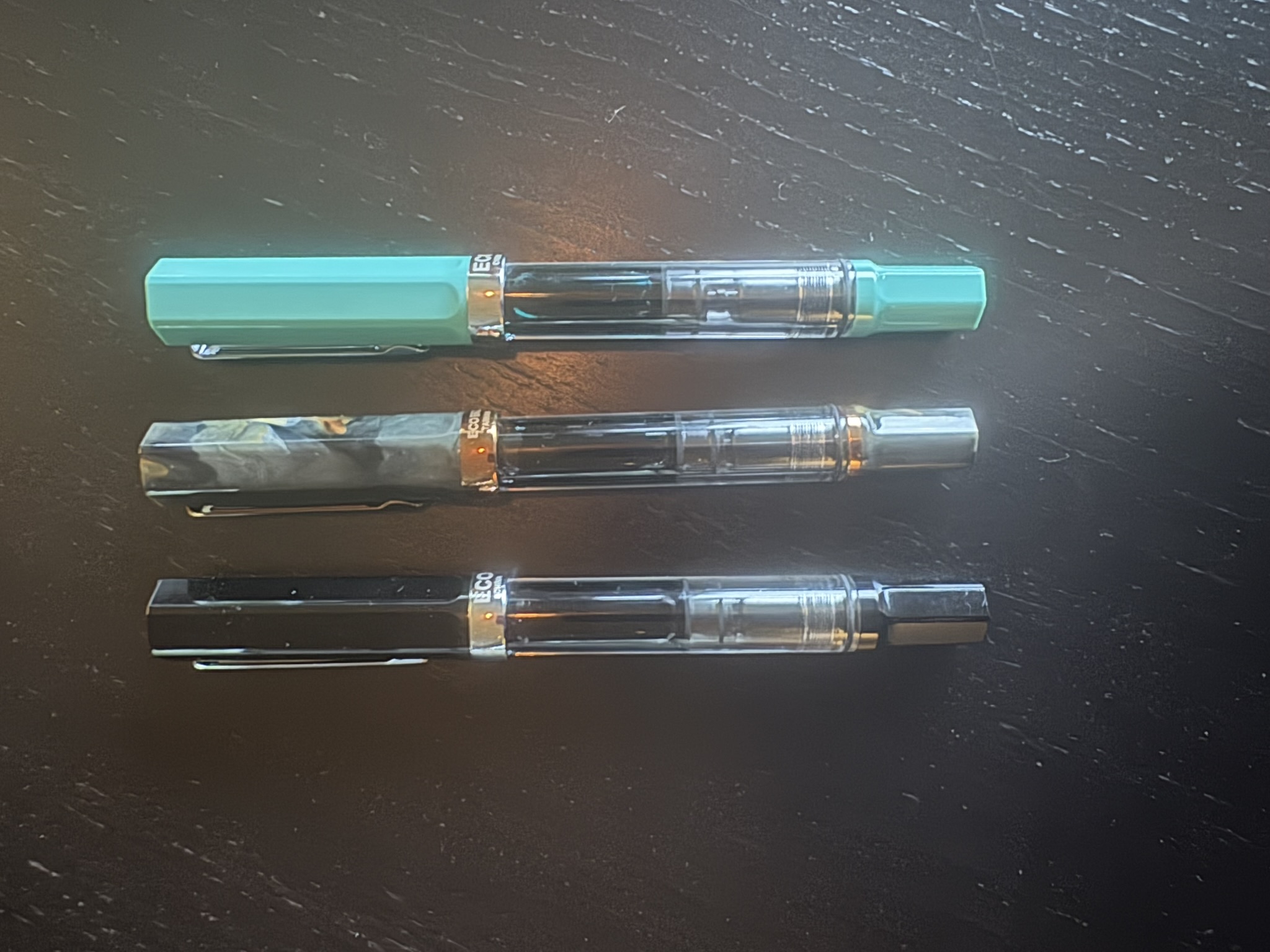
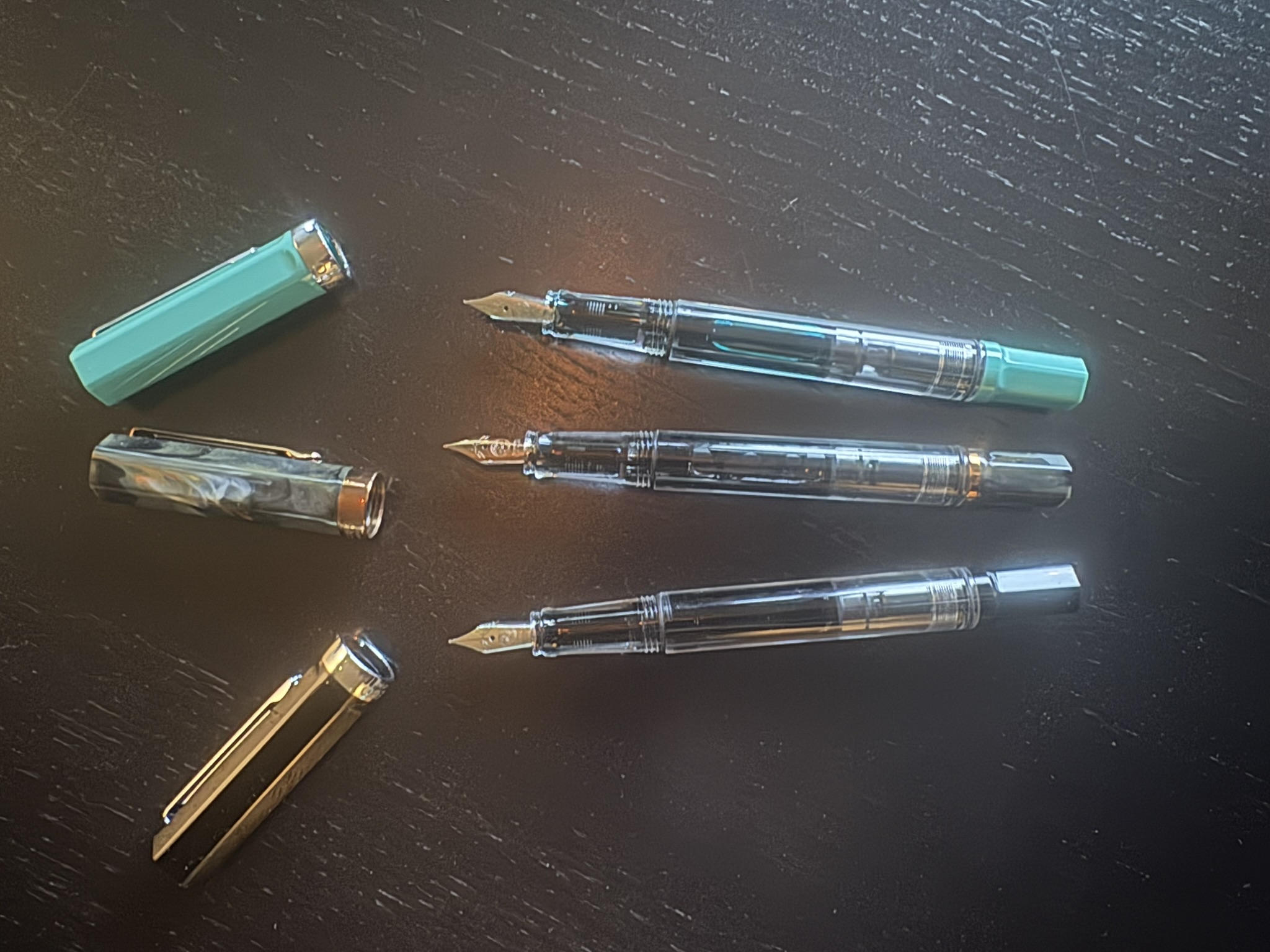
These days, I own three TWSBI ECOs. That probably tells you everything you need to know.

Three TWSBI ECO fountain pens

I've tried other fountain pens since, some more expensive and some less so, but the ECO still has a special place on my desk. Not because it's the most expensive. Not because it's the rarest. Because it was the one that introduced me to fountain pens in the first place.

"Sometimes your first favourite never really stops being your favourite."

The Daily Nib Verdict

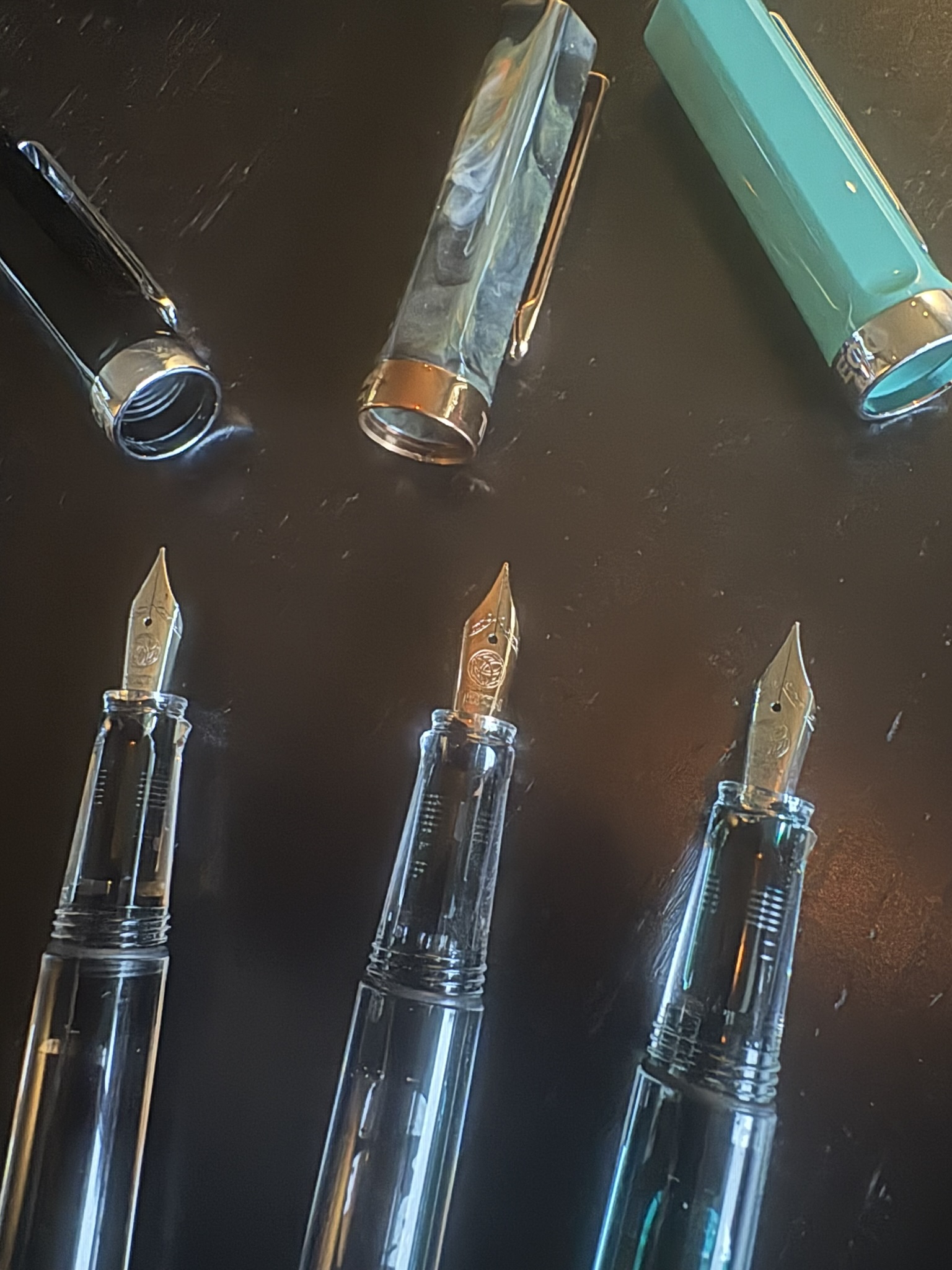
TWSBI ECO nibs close-up

If you've been curious about fountain pens but don't know where to begin, this is the pen I recommend more than any other.

Not because it's perfect. But because it's the one that made me fall in love with writing all over again.

Notebooks, Planners & Diaries The Story Behind Hobonichi

How one planner quietly changed my life — and why The Daily Nib exists at all.

The Story Behind Hobonichi

Some hobbies arrive slowly, building over years until you realise one day that they've quietly taken over a corner of your life. Others find you in an instant. Hobonichi was the latter.

I've always loved stationery — notebooks, diaries, beautiful pens, the particular excitement of cracking open something new. There has always been something deeply comforting about paper and the promise of a blank page. But I didn't know how far that love could go until a Hobonichi Techo landed in my hands for the first time.

Looking back, I honestly don't think The Daily Nib would exist if it hadn't. So it feels only right that this is where we begin.

A planner that started with a website

Surprisingly, Hobonichi didn't begin as a stationery company. Its story starts in 1998 with Japanese copywriter Shigesato Itoi, who launched a website called Hobo Nikkan Itoi Shinbun — usually shortened to Hobonichi. The site became known for its thoughtful essays, interviews, and reflections on everyday life. Rather than chasing productivity, it celebrated curiosity and paying attention to small moments that might otherwise go unnoticed. That philosophy, it turned out, would shape everything that came after.

In 2002, the first Hobonichi Techo was released.

The planner that didn't tell you how to plan

What made the Techo different wasn't what it offered — it was what it didn't demand. No productivity system to follow, no pre-printed time slots, no instructions on how to fill a page. Just one full page for every day of the year, printed on remarkable paper, and an unspoken invitation to decide for yourself what that page should become.

Some people use it as a planner. Others as a diary, a sketchbook, a scrapbook, a running log of books read and films watched and things overheard on the bus. The Hobonichi doesn't have a right way to be used, and I think that's exactly what draws people to it — and keeps them coming back year after year.

"Every Hobonichi slowly becomes a reflection of the person using it."

Why people fall in love

Part of the answer is the paper. Tomoe River paper is almost absurdly thin — a full year of daily pages fits into something barely thicker than a paperback — and yet it holds fountain pen ink beautifully, with almost no feathering or bleed-through. It shouldn't work. Somehow it does.

But the paper is only the beginning. What Hobonichi really does is make ordinary days feel worth documenting. A quiet morning, a good cup of coffee, a book you don't want to forget, a conversation that stayed with you longer than expected. Small things that might otherwise disappear. The Techo gives them a place to land.

Why it matters to me

When people ask why I care so much about stationery, I often think back to that first Hobonichi. It wasn't just a planner — it was a door. On the other side was Japanese craftsmanship, fountain pens, the strange pleasure of comparing paper weights, and the slowly dawning realisation that everyday objects, chosen with a little care, can bring genuine and lasting joy.

The Daily Nib exists, in a very real sense, because of that first planner. Thank you for being here.